

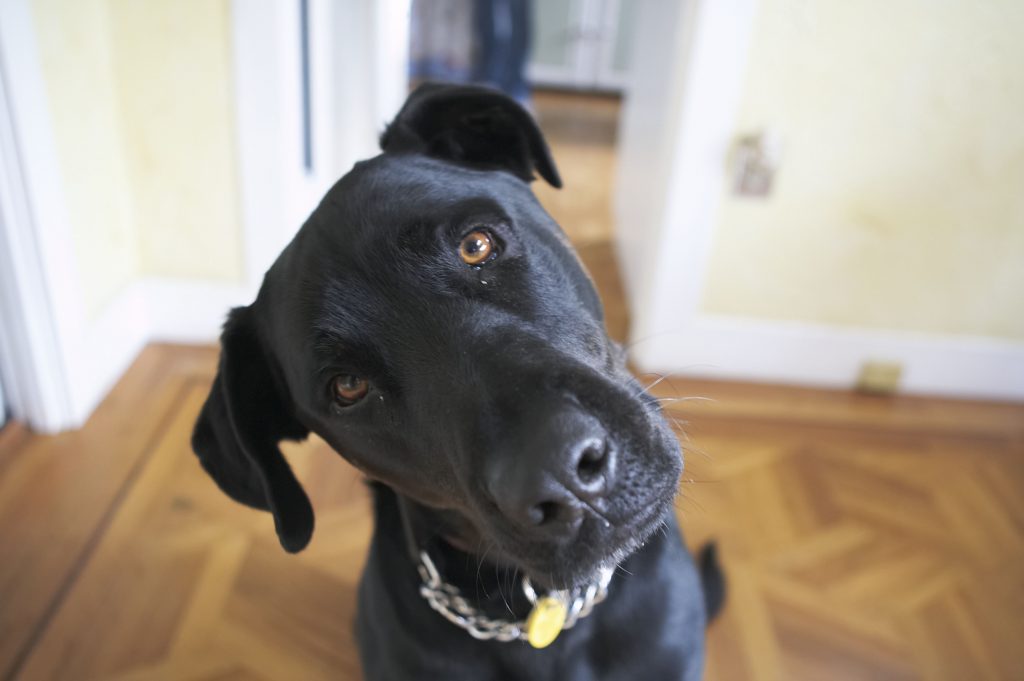
Familiar with the stance, you hold a particular fondness for it. An embodiment of photogenic charm, heartwarming allure, and smile-inducing charisma—the canine pose that truly captures hearts—the head tilt. In this endearing maneuver, dog owners find delight as their furry companions respond to intriguing sounds with uplifted countenances, inquisitive gazes, and ears alert like perky antennae.

But why do dogs incline their heads when met with unfamiliar sounds?
Canines possess a heightened auditory acumen, attuned to frequencies and noises that often elude human perception. However, an advantage humans hold over dogs lies in our ability to detect sounds from any direction without having to adjust our orientation. Unlike the external human ear, engineered with astute sound receptivity that eliminates the need to pivot towards sounds, a dog’s directional hearing faces limitations.
While the human ear’s intricate design ensures sound capture without spatial constraints, dogs confront a different scenario. Their ear flaps, known as pinnae, partially or fully veil their ear canals, impeding sound transmission and necessitating positional shifts for optimal auditory perception. Yet, the silver lining is that these canine pinnae are adaptable, permitting dogs to manipulate their ears to pinpoint precise sound origins. However, the challenges vary among breeds. A German Shepherd contends with partial hindrance, whereas a Cocker Spaniel grapples with the complete coverage of ear canals by its substantial ear flaps.